DDR SDRAM MEMORY
www.ddrsdrammemory.com

How to install computer memory RAM?

Fitting a DIMM RAM  module

What is DDR SDRAM Memory?
Which DDR SDRAM to buy?
The evolution of DDR SDRAM
What DDR SDRAM memory to buy?
Why buy DDR SDRAM Memory?
How much RAM do I need?
How to identify size of RAM modules ?
How to install memory?
How about mixing RAM brands?
DDR SDRAM Memory upgrade websites

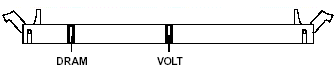
View of a DIMM slot showing the notches that must match those on a DIMM module

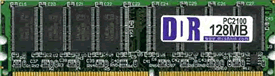
128MB DDR RAM module showing its single notch

Installing the DIMM modules (that have been used in all new computers for several years) is merely a matter of pushing the module directly down into the DIMM slot as shown in the diagram below. Note that the notche(s) along the connector edge of the module must match the divisions in the slot.

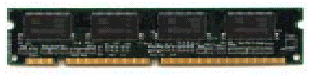
Depending on its architecture, there will always be at least one notch in a RAM module, but never more than two. The SDRAM module below has two notches, but a DDR DIMM module (below that) will only have one, and a RIMM module (used only in motherboards designed for Pentium 4 processors) has two closely-spaced notches.

Note that you should consult the motherboard's manual to find out if the slots have to be filled in an order of rank. Some motherboards require that Bank 0 be filled first, followed by Bank 1 and 2, etc., while some motherboards allow any bank to be filled.

Installing Computer Memory

Memory installation is a pretty easy upgrade to perform. Most of the work, if you could call it that, comes before you actually do the upgrade - in being sure you get the right kind of memory for your system.

SIMMs (EDO)

First some info, though. Your computer, if it uses 30-pin or 72-pin SIMMs, organizes its SIMM sockets into groups called banks. Some boards say that two sockets make a bank.

Some say that one is a bank. Nevertheless, a bank must be full. A half full bank will drive your computer nuts. Also, you can't mix two different kinds of memory in a single bank. For example, you can't put a 4MB SIMM and an 8MB SIMM in one bank and expect to get 12 MB of RAM. Also, many systems require you to put the memory in in pairs. Therefore, if you want 32 megs of RAM, you have to stick 2 16's in instead of one 32.  


Here's a shortcut which is almost always true. An older computer with a 386 or an early 486 chip usually has a 4 socket bank of 30-pin SIMM modules. A later model 486 requires only one socket of 72-pin modules. Pentium machines have two socket banks of 72 pin modules, meaning you must install RAM in pairs. In all of these systems, the bank must be full for your system to operate. Following these guidelines, lets say you want to add 16 meg of RAM to your Pentium machine. You could buy one 16MB SIMM, but this won't work because you will have a partially filled bank. You must buy two 8MB SIMMS instead, and install them in a pair.

  1. Turn off the computer, unplug it, and take off the case cover.

  2. Locate the memory slots.

  3. Remove the old memory (if applicable). This will entail loosening the little retainer springs on each end of the memory socket until the memory stick can be removed.

  4. Install the RAM. To do this, first locate the little notch on the pin-side of the module. This notch will line up with a notch on the memory socket itself, to ensure proper alignment. Position the module over the slot at a 45-degree angle with the module pins in the slot. Gently rotate the SIMM until it is in an upright position. When it is in an upright position, the retainer springs will snap into place and secure the SIMM.

  5. Repeat previous step for all remaining SIMMs you wish to install.

  6. Test it. Before you put your case back on, power on your system and make sure it correctly tallies the RAM.

  7. Close up the case.

DIMMs (SDRAM, DDR-DRAM)

Now, we can all thank God that SDRAM and DDR came out, or we'd all have to decipher all that bank stuff in order to upgrade memory. DIMMs are much simpler. Most motherboards have the 168-pin slots for SDRAM or 184-pin slots for DDR-DRAM. Each DIMM slot is a bank, so one can install these types of memory in any combination they want. It is best, if you have several open DIMM slots, to use the lowest number slots first. The slots are numbered, such as DIMM 0, DIMM 1, and DIMM 2. Choose the lesser, unused number. If this is the only module in the system, use DIMM 0. Some older motherboards have both SIMM and DIMM slots. On these, each DIMM slot is a bank, just like normal. The SIMM slots right next to them are usually paired in a bank, just like the normal Pentium bank setup.

  • Turn off the computer, unplug it, and take off the case cover.

  • Locate the memory slots.

  • Remove the old memory (if applicable). This will entail pressing down on the little ejector clips on each end of the memory socket until the memory stick pops out of the socket. Then you just life it out.

  • Install the RAM. To do this, first locate the little notches on the pin-side of the module. These notches (usually two) will line up with keys on the memory socket itself, to ensure proper alignment. With the ejector clips in the open position, position the module over the slot and begin pressing the module down into the slot. You will need to press down pretty hard. As you press down, the module will sink into place and the ejector clips will close themselves to lock the module into place.

  • Repeat previous step for all remaining DIMMs you wish to install.
    6. Test it. Before you put your case back on, power on your system and make sure it correctly tallies the RAM.

  • Close up the case.


Still confused about the different types of RAM?

It is very easy to become confused with the different types of RAM that will or will not run on the different types of motherboards that support Intel or AMD processors.

Start by remembering that motherboards that support Intel processors never support AMD processors, and you are half way towards clearing up the confusion.

The motherboard must support a given processor if you are to use it. It is then just an simple matter of consulting the motherboard's manual to find out the types of RAM and the processors that it supports.

You can download the manuals from the websites of most of the major motherboard manufacturers. As long as you only install items on a motherboard certified by its manual to run on or with it, you cannot go very far wrong.

Most systems that have motherboards that use SIMM memory modules require you to use matching pairs of modules to fill a bank of slots on your motherboard. If you fail to match them correctly, your system will probably not function properly.

For example, if you want to install 64MB of EDO RAM that comes in the outdated SIMM module form, you may have to install two matching 32MB modules instead of going with just one 64MB module, or one 32MB module plus two 16MB modules. Therefore, always check your system and motherboard manuals before you place an order.

Note that you do not need to install DIMM (SDRAM or DDR RAM) modules,in pairs. Modern motherboards are also often much more forgiving about which DIMM modules that can be fitted - they do not all have to be of the same capacity. - A 64MB module can be installed with 128MB and 256MB modules.

Remember, never skimp on quality when it comes to RAM.

Even when buying a new PC always obtain a system specification and check what make of RAM is installed.

Only grade-A memory will do, and it is only manufactured by the major manufacturers of RAM.

RAM is probably the most critical system component. Every bit of data passes through it to get to the processor, so it has to be 100% functional 100% of the time if data corruption is not to take place.

It is a fact that many program crashes can be attributed to cheap, error-prone or defective RAM. Therefore, if the system has generic, low-cost RAM, insist that grade A RAM from one of the major manufacturers is installed.

The major manufacturers of RAM are Crucial Technology (also known as Micron Technology), Rambus (http://www.rambus.com/) PNY (uses Siemens chips), Kingston, Corsair, LG, Hyundai, Mushkin, and Samsung.

If the vendor's advertisement, or system specification does not name the manufacturer, then it is usually generic RAM that is on offer, much of which is not likely to be grade A RAM.


Websites that sell DDR SDRAM Memory

Other Computer Memory Upgrades and Useful Links

What is Computer Memory? |How to buy right Computer Memory? |How to Install Computer Memory? | What are different kinds of Memory Upgrades? | How Laptop memory is different than desktop Memory? | How to install Notebook memory Upgrade? |What is DDR Memory? | What is difference between DDR SDRAM 184pin and Rdram 184 pin? | What is difference between pc2100,PC2700 and pc3200 memory? |How to find Difference between Printer Memory? |How to find and install HP Printer Memory upgrade? | What is Rdram Rambus with different speeds? | What is Cisco Memory? | How to Find Cisco Memory upgrade? | Dell Memory Upgrade |


support@ddrsdrammemory.com

Copyright © 2003
 

DDR SDRAM Memory
www.ddrsdrammemory.com


DDR SDRAM Memory RAM


Scan your system to find exact RAM

Live Support

 
DDR SDRAM Memory

   PC2100 266MHZ DDR SDRAM Memory

   PC2700 333MHZ DDR SDRAM Memory

   PC3200 400MHZ DDR SDRAM Memory

   200 PIN Laptop DDR SDRAM SODIMM

DDR2 SDRAM Memory

   PC2-6400 DDR2-800 DDR2 SDRAM Memory

   PC2-5300 DDR2-667 DDR2 SDRAM Memory

   PC2-4200 DDR2-533 DDR2 SDRAM Memory

   PC2-3200 DDR2-400 DDR2 SDRAM Memory

   DDR2 SDRAM SODIMM LAPTOP MEMORY


  Select your Computer or Laptop model to find exact RAM Memory Upgrades
  Select System

Find all types of DDR SDRAM Memory RAM, best quality DDR Memory and DDR2 SDRAM Memory Upgrades. We carry all types of DDR SDRAM speeds including PC2100 266Mhz DDR SDRAM, PC2700 333Mhz DDR SDRAM, PC3200 DDR 400Mhz RAM Memory. We also carry top brand Computer, Server DDR2 RAM, PC2 3200 DDR2 400Mhz Memory, PC2 4200 DDR2 533Mhz RAM, PC2 5300 DDR2-667Mhz RAM, DDR2 800Mhz PC2-6400 Memory RAM and Notebook SODIMM DDR2 RAM.

If you are not sure on which DDR Memory to select, please use our memory scanner to find the exact ram or contact our Live Support for help.

PC2100 266Mhz 184PIN DDR SDRAM Memory DIMM
DDR PC2100 266Mhz 256MB DIMM 512MB DIMM 1GB DIMM  
DDR PC2100 266Mhz ECC 256MB DIMM 512MB DIMM 1GB DIMM  
DDR PC2100 266Mhz ECC Registered 256MB DIMM 512MB DIMM 1GB DIMM 2GB DIMM
PC2700 333Mhz 184PIN DDR SDRAM Memory DIMM
DDR PC2700 333Mhz 256MB DIMM 512MB DIMM 1GB DIMM  
DDR PC2700 333Mhz ECC 256MB DIMM 512MB DIMM 1GB DIMM  
DDR PC2700 333Mhz ECC Registered 256MB DIMM 512MB DIMM 1GB DIMM 2GB DIMM
PC3200 400Mhz 184PIN DDR SDRAM Memory DIMM
DDR PC3200 400Mhz 256MB DIMM 512MB DIMM 1GB DIMM  
DDR PC3200 400Mhz ECC 256MB DIMM 512MB DIMM 1GB DIMM  
DDR PC3200 400Mhz ECC Registered 256MB DIMM 512MB DIMM 2GB Kit 2GB DIMM


200 Pin DDR SDRAM Memory SODIMM
PC2100 266Mhz 200PIN DDR SDRAM SODMM
DDR PC2100 266Mhz 256MB SODIMM 512MB SODIMM 1GB SODIMM
PC2700 333Mhz 200PIN DDR SDRAM SODMM
DDR PC2700 333Mhz 256MB SODIMM 512MB SODIMM 1GB SODIMM
PC3200 400Mhz 200PIN DDR SDRAM SODMM
DDR PC3200 400Mhz 256MB SODIMM 512MB SODIMM 1GB SODIMM


Top Selling DDR SDRAM DIMM Desktops Memory

  1Gig (1024MB) DDR SDRAM PC3200 400MHZ DIMM

  1Gig (1024MB) DDR SDRAM PC2700 333MHZ DIMM

  2GB DDR PC2100 266Mhz ECC Registered DIMM

  2GB DDR PC3200 400Mhz ECC Registered DIMM


 Top Selling DDR SDRAM SODIMM Notebook Memory

  1GB DDR PC2700 333Mhz SODIMM

  1GB DDR PC3200 400Mhz SODIMM

  512MB DDR PC2700 333Mhz SODIMM

  512MB DDR PC3200 400Mhz SODIMM


PC2 3200 400Mhz 240 Pin DDR2 SDRAM Memory DIMM
DDR2 PC2-3200 400Mhz 512MB DIMM 1GB DIMM 2GB DIMM    
DDR2 PC2-3200 ECC 400Mhz 512MB DIMM 1GB DIMM 2GB  DIMM    
DDR2 PC2-3200 ECC Registered 400Mhz 512MB DIMM 1GB DIMM 2GB  DIMM 4GB  DIMM  
PC2 4200 533Mhz 240 Pin DDR2 SDRAM Memory DIMM
DDR2 PC2-4200 533Mhz 512MB  DIMM 1GB DIMM 2GB DIMM    
DDR2 PC2-4200 ECC 533Mhz 512MB DIMM 1GB  DIMM 2GB DIMM    
DDR2 PC2-4200 ECC Registered 533Mhz 512MB DIMM 1GB DIMM 2GB DIMM 4GB DIMM  
DDR2 PC2-4200 ECC Fully Buffered 533Mhz 512M DIMM 1GB DIMM 2GB Kit 4GB Kit 8GB Kit
PC2 5300 667Mhz 240 Pin DDR2 SDRAM Memory DIMM
DDR2 PC2-5300 667Mhz 512MB DIMM 1GB DIMM 2GB DIMM    
DDR2 PC2-5300 ECC 667Mhz 512MB DIMM 1GB DIMM 2GB DIMM    
DDR2 PC2-5300 ECC Registered 667Mhz 512MB DIMM 1GB DIMM 2GB DIMM 4GB DIMM  
DDR2 PC2-5300 ECC Fully Buffered 667Mhz 512MB DIMM 1GB DIMM 2GB Kit 4GB Kit 8GB Kit
PC2 6400 800Mhz 240 Pin DDR2 SDRAM Memory DIMM
DDR2 PC2-6400 800Mhz 512MB DIMM 1GB DIMM


200 Pin DDR2 SDRAM Memory SODIMM
PC2 3200 400Mhz 200 Pin Memory DDR2 SODIMM
DDR2 PC2-3200 400Mhz 512MB SODIMM 1GB SODIMM  
PC2 4200 533Mhz 200 Pin Memory DDR2 SODIMM
DDR2 PC2-4200 533Mhz 512M SODIMM 1GB SODIMM 2GB SODIMM
PC2 5300 667Mhz 200 Pin Memory DDR2 SODIMM
DDR2 PC2-5300 667Mhz 512MB SODIMM 1GB SODIMM 2GB SODIMM